
Joseph Stiglitz says India should not bothered on inflation and instead focus on rapid growth.

Department of Economic Affairs secretary Atanu Chakraborty said that equity capital flows have been positive this year.

The last three prime ministers who served full terms started out in their early 70s. Mr Modi is younger and fitter than all of them. But he needs to find it in him to change course if he is to beat the odds, notes T N Ninan.

The Union Budget on Wednesday outlined several initiatives to drive India's technology agenda and boost digital infrastructure, including new centres of excellence for artificial intelligence, National Data Governance Policy, and Entity DigiLocker.

The outcome is beyond the market's expectation and will be a sentimental boost, say analysts.
When he speaks of them, it is either in denial or to highlight successes that are only part of a larger story that is worrisome in its totality, observes T N Ninan.

This year, festive sales are expected to push up the annual gross merchandise value of e-commerce companies to around $38 billion, a 40 per cent growth over the previous year.

He wants Jaitley to give investors more clarity on policies
For the first time in our economic history a government has thought about more than 50 per cent of our economic activity instead of the five per cent represented by the Sensex companies, observes IIM-B professor R Vaidyanathan.

A lesson we have not learnt from China is the urgent need to knit the vast country together to keep it from falling apart at the seams. While there is considerable dent in poverty, sadly, the North East remains as distant today as it always was, points out Shreekant Sambrani.

'Rather than cutting and pasting from advanced economies, we should use basic economic principles to think about what is right for India at the stage of development at which we are,' says Chief Economic Advisor Krishnamurthy Subramanian.
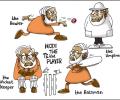
'Nationalism built on divisiveness cannot strengthen the country, or help the economy improve its performance,' points out T N Ninan.

Human Development -- a measure of a nation's health, education, and average income -- has declined for two years in a row.

'We see the defence industry as one of the leading sectors, which will significantly contribute to the growth of the Indian economy, but more importantly, bring atmanirbharta to national security.'

If Walmart is spinning success stories of Indian manufacturers in global markets, Amazon is taking 'Make in India' to the world, bolstered by its 'Global Selling Programme'
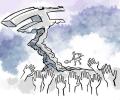
Banks should neither be timid nor adventurous while lending as the loans of today should not become NPAs of tomorrow, he said.

Hawkish tone likely to guard rupee from further slide

Finance Minister Nirmala Sitharaman presents her fourth Budget in Lok Sabha on Tuesday.
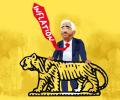
The RBI's mistake may have been in interpreting its mandate to maintain retail inflation at 4%, with 2% leeway in either direction, as being a mandate that permitted it to do nothing even when inflation was at or near the upper bound of 6%, observes T N Ninan.

To help revive the economy battered by COVID-19, Finance Minister Nirmala Sitharaman on Monday announced a slew of measures, including Rs 1.1 lakh crore credit guarantee scheme for improving health infrastructure, and enhancing the limit under the ECLGS by 50 per cent to Rs 4.5 lakh crore for the MSME sector facing liquidity crunch. Sharing the details of stimulus package, the finance minister said this comprises eight relief measures and other eight measures to support the economic growth. She announced Rs 1.1 lakh crore loan guarantee scheme for COVID-affected sectors, including health sector, which includes guarantee cover for expansion or for new projects. Besides, she said, additional Rs 1.5 lakh crore limit enhancement done for Emergency Credit Line Guarantee Scheme (ECLGS) scheme.
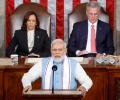
Here's the full text of Prime Minister Narendra Modi's address to a joint session of the United States Congress, delivered on Thursday.
'A strong foreign exchange reserve is the best safety net against global spillovers.'

Renowned Indian environmental economist and UN Environment Programme (UNEP) goodwill ambassador Pavan Sukhdev has won the 2020 Tyler Prize, regarded as the 'Nobel Prize for the Environment', for his ground-breaking "green economy" work. Sukhdev, 59, who will receive the award alongside conservation biologist Gretchen Daily, has been acknowledged for his work on bringing the economic consequences of environmental degradation and loss to the attention of corporate and political decision-makers.

We need transformative policies and incentives with purpose, especially in solar power and digital infrastructure.

PSU divestment, LIC IPO, fiscal deficit: Budget 2021 marks a clear change in the Modi government's stance from fiscal conservatism to growth orientation.

Indian equities are no longer cheap vis-a-vis global markets, and only a short distance away from being the most expensive they have ever been.

As India gets ready to roll out one of the largest vaccine programmes, billionaire Mukesh Ambani on Tuesday said his group is working with authorities to provide technology tools and backbone for mass inoculation against COVID-19. Ambani's telecom venture Jio was rolled out four years back, offering free voice calling and dirt-cheap data. Today, Jio is India's largest telecom operator with over 400 million users, each connected to the internet. At a Facebook event, Ambani said the government's digital push kept the country running even during the pandemic and is now helping in the rollout of one of the largest vaccination programmes.
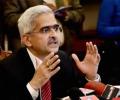
The Reserve Bank of India on Friday decided to leave benchmark interest rate unchanged at 4 per cent but maintained an accommodative stance as the economy faces heat of the second Covid wave.

Several individuals and organisations, including the US Chambers of Commerce and the National Association of Manufacturers, have filed a lawsuit against the Trump administration's recent rules related to the H-1B visa, terming them "arbitrary" and "haphazard" regulations that will undermine high skilled immigration into America. Early this month, the Trump administration announced new restrictions on H-1B non-immigrant visa programme which it said is aimed at protecting American workers, restoring integrity and to better guarantee that H-1B petitions are approved only for qualified beneficiaries and petitioners, a move which is likely to affect thousands of Indian IT professionals.
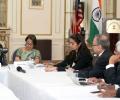
The power minister briefed the investors on various steps undertaken by the government.
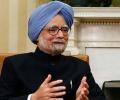
There is a need for tax reforms in the country in a bolder way, Singh said.

There was no clear winner between former chancellor Rishi Sunak and Foreign Secretary Liz Truss on Tuesday after the UK's prime ministerial candidates went head-to-head in their first television debate as finalists and clashed fiercely on their economic policies and tax plans.

'In the overall global portfolio, India's weighting has come down in the past seven months.'

The focus of the Union Budget is on providing basic amenities to the poor, middle class and youth, Prime Minister Narendra Modi said on Wednesday, and asserted that it is imperative that India becomes self-reliant.

In less than a week of Donald Trump being sworn in as the 45th US President, the "H-1B and L-1 Visa Reform Act" was introduced to prioritise American workers and restore fairness in visa programmes for skilled workers.

In response the BRICS - Brazil, Russia, India, China and South Africa - have taken steps to strengthen cooperation such as setting up a joint development bank

Could it have been more reformist? Of course, but this is an election year Budget, observes Akash Prakash.

It is true that the rupee is at least becoming less strong, albeit slowly.

'IIM Ahmedabad has seen one of the best placement seasons ever and this change can be attributed to the markets opening up after the pandemic.'

India's network has expanded at a compound annual rate of around 4% which has added more than 4.8 km of additional roads since 1951, but even so the network remains badly underdeveloped
